You can feel the pattern before the dashboard confirms it. Traffic is up, ad spend is up, the product looks better than it did six months ago, and yet the percentage of visitors who buy is stuck where it’s been for months, or sliding a little lower each week.
That’s the part many teams don’t talk about openly enough. Ecommerce conversion optimization isn’t only about squeezing a few more orders out of the same visits, it’s about protecting margin, protecting brand perception, and making sure growth doesn’t depend on deeper discounts every time the quarter gets tight.
The Conversion Problem Shopify Operators Keep Hitting
A lot of Shopify stores look healthy on the surface because the top of the funnel stays busy. Sessions keep coming in from paid, email, search, and social, but the path from visit to purchase still leaks at every step. The team keeps buying more traffic to cover a weak conversion rate, then profit starts to feel fragile.
That fragility shows up fast when growth depends on heavier promos instead of cleaner buying behavior. A store can add spend, raise traffic, and still end up in the same place if product pages, cart flow, and checkout keep causing hesitation.
What operators usually see first
The warning signs usually arrive as a slow grind, not a sudden collapse. Add-to-cart intent softens. Mobile performance lags. Checkout drop-off rises once buyers hit shipping surprises, account friction, or weak trust signals.
Practical rule: if your traffic mix is changing but your conversion rate is not, treat that as a measurement problem first and a creative problem second.
Mobile often makes the gap harder to spot. Many ecommerce sites still get most of their traffic on phones, but phone performance can trail desktop badly, and slow pages make that worse. A store can look functional and still underperform where it matters most.
For Shopify teams, the pressure usually builds in the same place. Paid traffic gets more expensive, the promo calendar gets louder, and the default response is to keep pushing more volume through the same weak funnel. Conversion work is the cleaner lever, but only when the changes are tied to real behavior, not assumptions. If you want a practical reference point, the team at optimize conversions like a pro frames it around fixing the path to purchase, not just polishing the surface.
The better way to read the problem is from the business side. Conversion is not just a percentage on a dashboard. It decides how much margin survives each campaign, how much brand trust the store can hold, and whether urgency comes from a limited offer with boundaries or from another blanket discount that trains buyers to wait.
Defining Ecommerce Conversion Optimization for Shopify Teams
A Shopify store does not need more traffic before it needs better conversion. If a campaign is already bringing people in, the question is how much of that intent turns into revenue, how much slips away, and what kind of pressure the store puts on margin while it tries to close the gap.
Ecommerce conversion optimization is the work of improving the share of sessions that complete a useful action, usually a purchase, but sometimes a signup, add to cart, or another step that shows buying intent. For a merchant, the point is simple: get more out of the traffic already paid for, without relying on constant acquisition spend to cover weak funnel performance.
CRO is not a redesign project
A common mistake is treating CRO like a theme refresh. A prettier store can help, but if the funnel still has dead ends, slow load times, weak trust signals, or a clunky checkout, the visual work will not carry much weight.
CRO works as a measurement loop. Observe behavior, identify where friction appears, change one thing at a specific funnel step, then check whether the change improved the outcome you care about. That is why a serious program starts with evidence, not opinions about what should look better.
The cleanest definition for a Shopify team
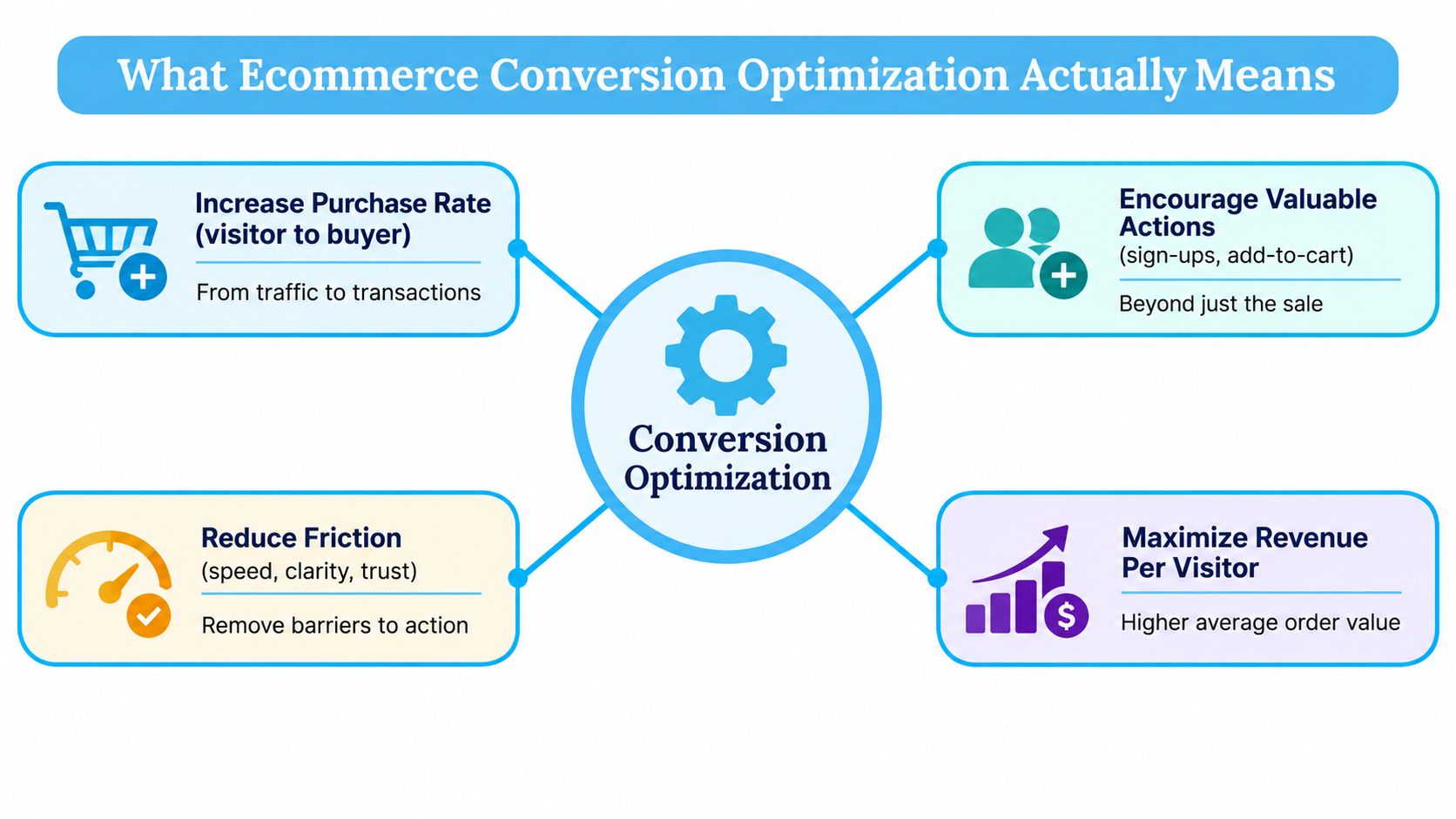
Ecommerce conversion optimization has four jobs.
- Increase purchase rate. Turn more visitors into buyers.
- Encourage valuable micro-actions. Get more sign-ups, cart adds, and product engagement that move people toward revenue.
- Reduce friction. Remove speed, clarity, and trust problems that block action.
- Raise revenue per visitor. Improve basket size or purchase completion, not just order count.
If you want a practical reference point, the guide to ecommerce performance metrics for Shopify teams is a useful companion read. For a broader overview of the discipline, optimize conversions like a pro frames the work around fixing the path to purchase, not polishing the surface.
The point is more commercial than cosmetic. Conversion is a margin problem and a brand equity problem. More of the same traffic should create more orders, but the route matters. A store can chase volume with blanket discounts and train buyers to wait, or it can use behavior-driven urgency, capped rewards, time limits, and quantity bounds to lift conversion with a lighter average discount.
Traffic generation and conversion optimization do different jobs. Traffic creates visits. Conversion work makes those visits worth more. When acquisition costs rise, that difference stops being theoretical.
Key Metrics and Diagnostics Every Shopify Store Needs
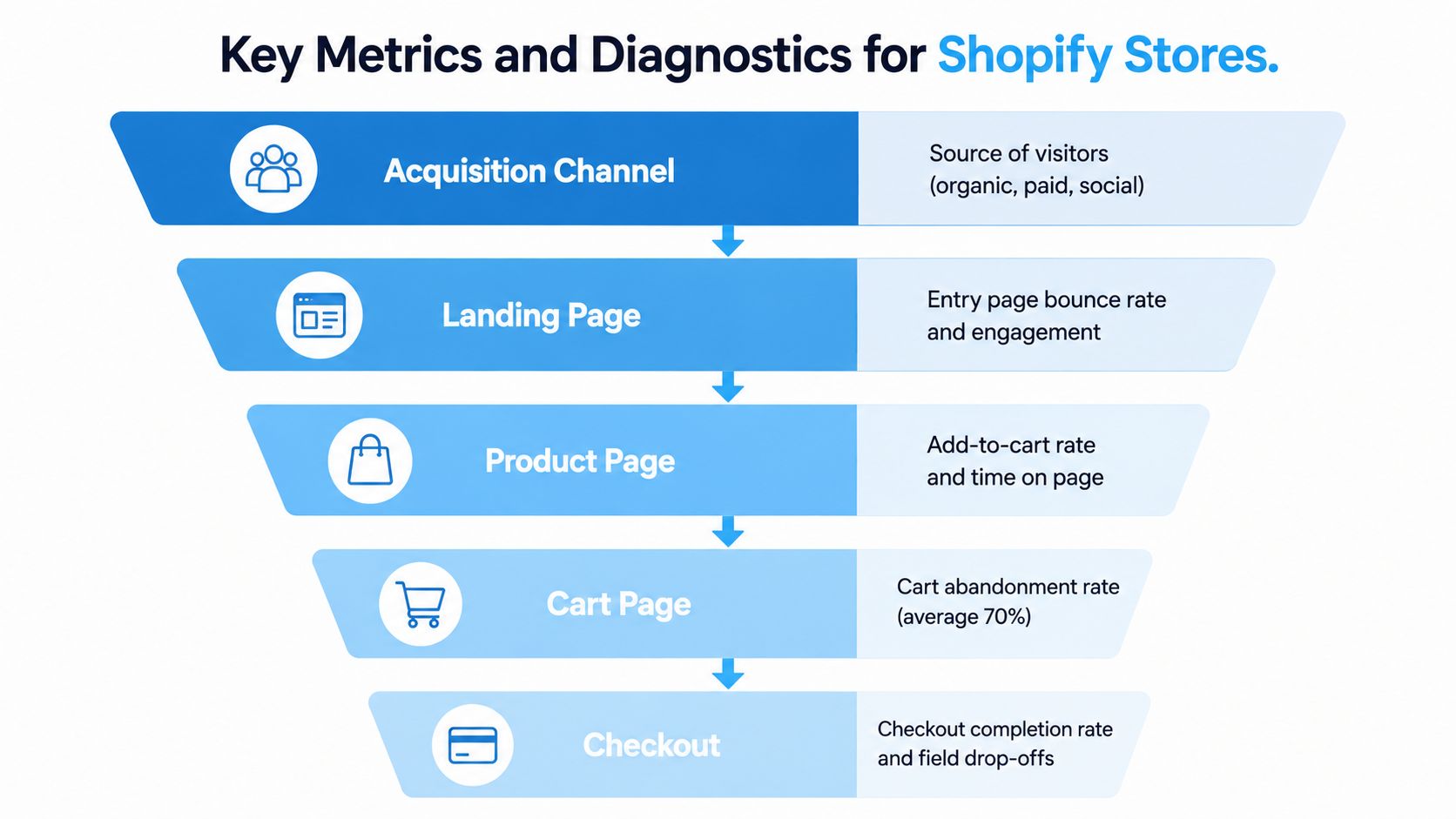
A store can be spending money on ads, email, and creative while losing buyers at the same points every week. The fix starts with a clean view of the funnel. Trace the path from acquisition channel to landing page to product page to cart to checkout to purchase, then compare that path by device and source so the worst leak does not get hidden inside an average.
The first five numbers I would check are conversion rate, cart abandonment, bounce rate, engagement time, and views per session. Those metrics tell you whether the issue is traffic quality, product-page friction, checkout failure, or a broader UX problem that needs a closer look.
What each layer tells you
Acquisition channel shows which traffic sources behave differently. Email often outperforms colder channels, search and returning visitors usually convert better than first-time visitors, and each channel needs to be read on its own terms. The simplest way to do that is to keep a reliable ecommerce performance metrics view open while you compare source, device, and conversion outcomes.
Landing page shows whether the promise from the ad, email, or search result matches what people see. High bounce with weak engagement time usually means the page did not answer the visitor’s question fast enough.
Product page shows whether the offer is clear enough to move someone from interest to intent. If people are viewing products but not adding them to cart, the issue may be product information, trust, pricing clarity, or an experience that feels too thin on mobile.
Cart page is where intent starts to fall apart if shipping, taxes, or extra friction appear too late. This is also where a store can turn a strong offer into a weak one. A broad discount can lift short-term conversion, but it can also train buyers to wait for the next markdown. Behavior-driven urgency works better here when it is bounded, with capped rewards, time limits, or quantity limits that create a real reason to act without giving away more margin than necessary.
Checkout shows whether the store is closing the sale or making the buyer work too hard. Track field drop-off, step completion, and payment friction, not just the final order count.
Operator note: if you do not know which device segment is underperforming, you are probably optimizing the wrong screen.
When to add heatmaps and recordings
GA4 and Shopify analytics can tell you where drop-off happens. Heatmaps, session recordings, and form analytics tell you why. Add them when the numbers point to a specific page but the reason for the friction still is not obvious, because scroll abandonment, dead clicks, and field-level friction do not show up cleanly in aggregate reports.
That is also where instrumentation matters more than a redesign. A store with enough traffic can learn a lot from controlled experiments, but only if the baseline is clean enough to trust. If you cannot describe the funnel step where people disappear, you are not ready to test with any confidence.
High-Impact Tactics That Move the Needle
The strongest conversion work usually starts with the experience itself. If the store feels slow or awkward on mobile, every other tactic loses efficiency because buyers have already hit friction before they even see the offer.
Start with the experience, not the promotion
Mobile and speed shape the baseline. Mobile shoppers often convert at lower rates than desktop users, even when mobile drives most of the traffic, and slow-loading pages can drag conversions down even further. That makes page speed and responsive UX a conversion issue, not a cleanup task.
Practical rule: fix the page that loads slowly before you debate whether the offer is strong enough.
On Shopify, that usually means cutting heavy apps, trimming theme bloat, compressing media, and checking whether product pages still work well one-handed. It is unglamorous work, but it often removes more friction than a fresh promotion ever will.
Then cut checkout friction hard
Checkout is where a lot of sales die. Teams lose buyers when they ask for too much information, add interruptions at the wrong time, or make payment feel uncertain right as the shopper is ready to commit.
The clean behavioral principle here is commitment and consistency. Once someone has added to cart, every extra step gives them another chance to back out. Reducing form fields, allowing guest checkout, and making payment options obvious all respect the momentum already built.
A practical next move is to review your flow against a detailed guide to Shopify checkout optimization. The point is not to chase a perfect checkout, it is to remove the small points of hesitation that stack up into abandonment.
Use pricing and urgency with more discipline
Blanket discounts are the blunt tool many stores reach for first. They can move volume, but they also train shoppers to wait. That is where temporal discounting and loss aversion matter, because people act when the opportunity feels timely and finite, not when the store keeps teaching them that patience pays.
Behavior-driven urgency works better when the offer is capped by time or quantity, or both. A capped reward is different from an always-on markdown because the shopper has a reason to act now without expecting the same deal next week. That protects margin better than broad discounting, and it keeps the brand from looking like it always needs a price cut to move product.
The tactic can show up in the storefront, email, SMS, and post-click flows, but consistency matters. If the offer feels like a gimmick in one place and a real opportunity in another, trust drops.
Personalization and lifecycle messaging still matter
Personalization works best when it is tied to real behavior, not a vague instruction to segment harder. Returning visitors can see different offers than first-time visitors, product recommendations can reflect browsing history, and abandoned cart flows can reference the exact items left behind.
Email and SMS are especially useful after the click because they carry the conversation forward. They work best when the message is specific, the timing fits the shopper’s behavior, and the offer does not feel like a random blast.
For teams testing urgency-based promotions, Quikly is one Shopify option that lets offers be bounded by time or claim count, so the promotion feels earned rather than automatic. The broader lesson is bigger than any one tool. If your tactics reward the shopper who acts, you do not have to rely as hard on deeper discounts to get movement.
Why More Conversions Can Cost You Margin and Brand
Most ecommerce advice treats a higher conversion rate as a clean win. On paper, that sounds right. In practice, the math gets messy fast. If the only way to move volume is to keep deepening discounts, you are buying conversion with margin you may not have room to lose.
Shopify brands run into this when the same promotion shows up again and again. Customers notice the pattern. Once they expect a better deal next week, the store trains waiting behavior instead of buying behavior, and the next full-price offer has to fight harder for attention.
The hidden cost of discount conditioning
A flat discount tells shoppers to buy whenever they feel like it. That can work for a while, but it also sets a price ceiling in the customer’s mind. When people assume another sale is coming, full-price conversion gets harder, not easier.
Brand perception takes a hit too. Frequent markdowns can make a store look less confident in its product, even when the product is strong. Then the loop gets weaker, full-price trust slips, the brand leans harder on promos, and the next campaign has to carry more weight just to keep sales moving.
For a useful angle on the behavioral side of this, the internal read at scarcity marketing explains why urgency changes the decision window instead of just the message. The useful part is not the slogan. It is the discipline around when an offer should exist and who should see it.
How to judge an optimization idea
Every test should be judged against more than conversion rate. Ask whether it protects or weakens margin per order, whether it trains customers to wait, and whether it makes the brand feel more premium or more transactional.
A few questions keep the team honest.
- Does this tactic require a deeper discount to work? If yes, the lift may be expensive.
- Does it reward early action? If not, it may be teaching the wrong habit.
- Would customers respect this if they saw it again next month? If the answer is no, the tactic may be borrowing against brand equity.
That is the cleaner frame for Shopify operators. More conversions matter, but not if the only path is turning the store into a permanent sale rack. The better target is stronger conversion with less erosion, and behavior-driven urgency helps there because capped rewards, time limits, and quantity bounds can move shoppers without pushing the average discount as far as blanket markdowns.
A 90-Day CRO Playbook for Shopify and DTC Brands
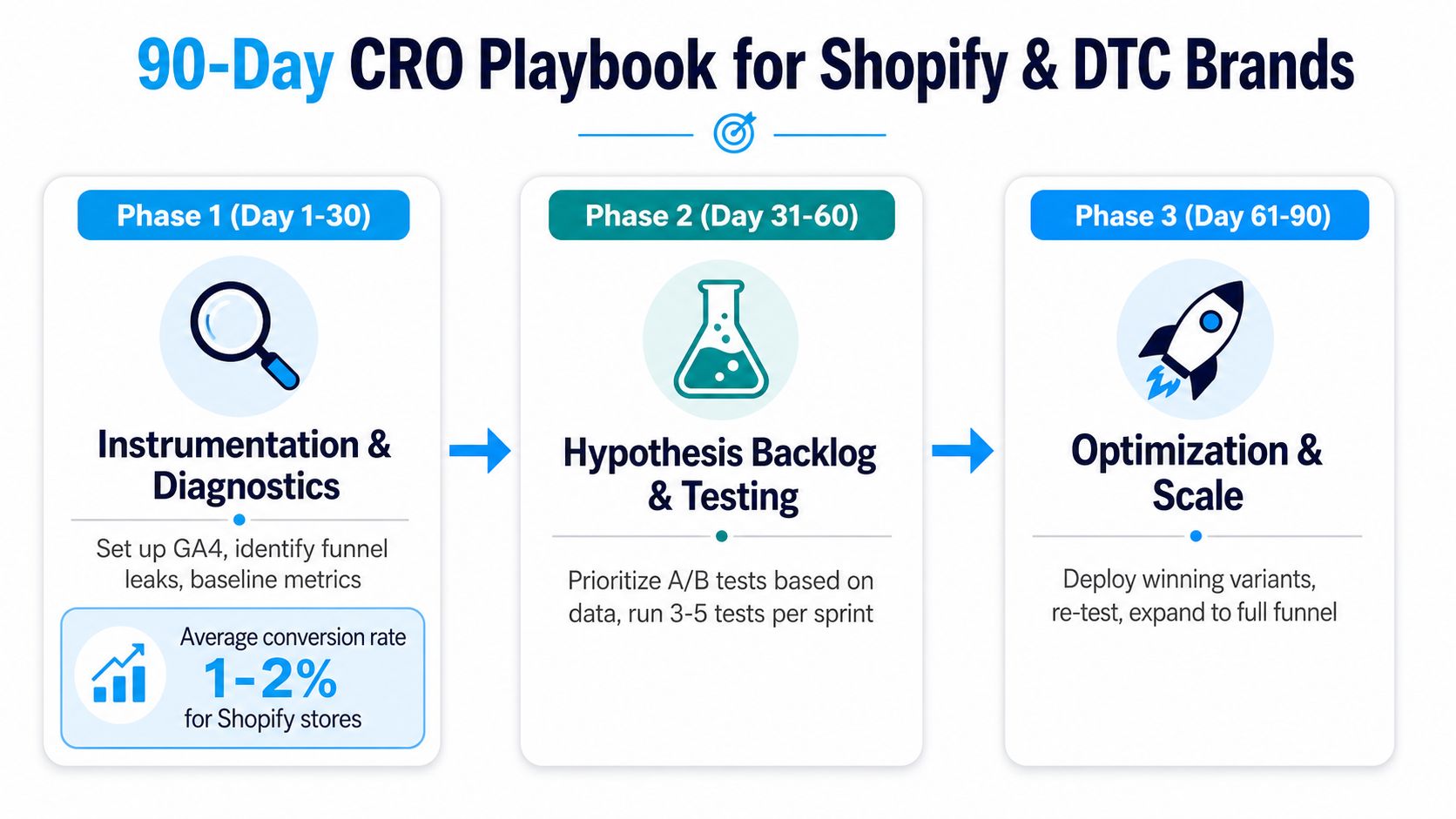
The first 30 days should be about visibility, not cleverness. Set up GA4 funnels, compare device segments, and baseline the drop-off points from acquisition through checkout so the team knows where the leak is.
The next 30 days should turn that data into a ranked backlog. Prioritize tests by likely impact and confidence, not by whoever has the loudest opinion in the room. If monthly traffic is limited, start with the biggest-funnel issues, because tiny tests on tiny pages can take too long to teach you anything useful.
What to do in each phase
Days 1 to 30. Clean up instrumentation, confirm the funnel, and document the obvious friction on mobile, product pages, cart, and checkout. If you can’t explain the drop-off in one sentence, you’re not ready to optimize it.
Days 31 to 60. Build a test queue inside your Shopify app stack, theme settings, and email or SMS tools. Run a small number of high-confidence experiments, such as simplifying checkout, clarifying pricing, changing product-page hierarchy, or testing a bounded offer flow.
Days 61 to 90. Roll winners forward, re-test anything ambiguous, and widen the scope only after the original change proves itself. Winning ideas should be deployed with enough discipline that you can tell whether the lift holds when the novelty fades.
Testing tools matter here, but only as the container for the thinking. A/B tests are useful when they isolate one variable, hold the rest steady, and give you a clean read on behavior instead of a vague sense that “the page feels better.”
The Shopify reality is simple. Your app ecosystem, theme customization, discount rules, cart logic, and Klaviyo or SMS integrations are part of the conversion system. Treat them that way, and the work gets easier to prioritize.
Turning Conversion Gains Into a Durable Advantage
The best ecommerce conversion optimization programs don’t just lift the rate for one campaign. They build a system that converts better without making the store more dependent on deeper discounts, louder banners, or short-term tricks that train the wrong habit.
That’s where behavior-driven urgency matters. When a reward is capped by time or quantity, shoppers have a reason to act now, but the brand doesn’t have to teach them that waiting is always smarter. The offer stays tied to action, not to discount fatigue.
The sharper planning question is not “How do we get more conversions?” It’s “Which promotions reward the shoppers who act, and which ones train everyone else to wait?” That question changes the quality of the discussion fast.
If you want one concrete move this week, audit your current offers and separate the ones that depend on blanket markdowns from the ones that could be turned into bounded, on-brand experiences. Then test one promotion that rewards early action instead of passively waiting.
Quikly helps Shopify teams run urgency-based promotions that are capped by time, quantity, or both, so the incentive is tied to action instead of blanket discounting. If you’re trying to lift conversion without leaning harder on margin, visit Quikly and look at how behavior-driven promotions fit into your next CRO test.
Topics: ecommerce conversion optimization, Shopify CRO, conversion rate, DTC marketing, urgency promotions