A shopper lands on your Shopify store, adds a product to the cart, and pauses. They’ve seen the product they want, but they also know a coupon may arrive tomorrow. Your team responds with another discount, hoping to turn hesitation into a purchase. The order might come through, but the margin gets thinner and the customer learns to wait.
That pattern creates three familiar pressures: conversion stays insufficient, margins shrink, and brand value starts to depend on the next markdown. Real time offer management gives merchants another way to respond. Instead of discounting everyone more, it makes the offer relevant to the shopper’s current moment and rewards action while the opportunity is available.
Introduction Why Waiting Wins and How to Change It
Flat promotions often tell customers they can buy whenever they like. A sitewide code has no meaningful expiration from the shopper’s perspective if the brand regularly replaces it with another code. Predictable discounts can turn purchase intent into a waiting game, especially when visitors already expect a better offer to appear.
That creates a difficult operating loop for Shopify brands. Paid traffic arrives, product interest is visible, and carts build, but the shopper delays. The brand then adds more urgency copy, lowers the price, or sends another email. The immediate sale may improve, yet the business pays for it through discount erosion and weaker full-price behavior.
The problem isn’t that promotions have stopped working. The problem is that many promotions reward waiting. Research on strategic waiting in ecommerce frames discounting as a pricing problem shaped by consumers who delay purchases while they look for a better deal, as described in this research on wait-and-see behavior in ecommerce pricing.
The cost of discounting after hesitation
A shopper with strong intent doesn’t always need a larger discount. They may need a clear reason to decide now. That reason could be limited availability, a reward tier that changes as people claim it, or an offer that’s available only during a defined buying moment.
This distinction matters because conversion alone doesn’t tell you whether a promotion worked economically. A campaign can increase orders while lowering contribution margin, training customers to postpone purchases, or making the brand feel permanently promotional. A better offer changes the timing of action without automatically increasing the depth of the discount.
The opportunity is substantial but underused. A 2021 Boston Consulting Group analysis found that vendors and U.S. retailers spent only about 5% of their $140 billion to $200 billion trade and shopper marketing budgets on personalized offers. BCG argued that the share should be at least 25% overall and 50% in some categories, describing personalized offers as roughly a $70 billion growth opportunity.
This guide focuses on the practical version of that shift: what real time offer management means, why behavioral principles make it effective, how the underlying system protects accuracy, and how Shopify teams can launch without sacrificing margin or brand perception.
What Real Time Offer Management Means for Ecommerce
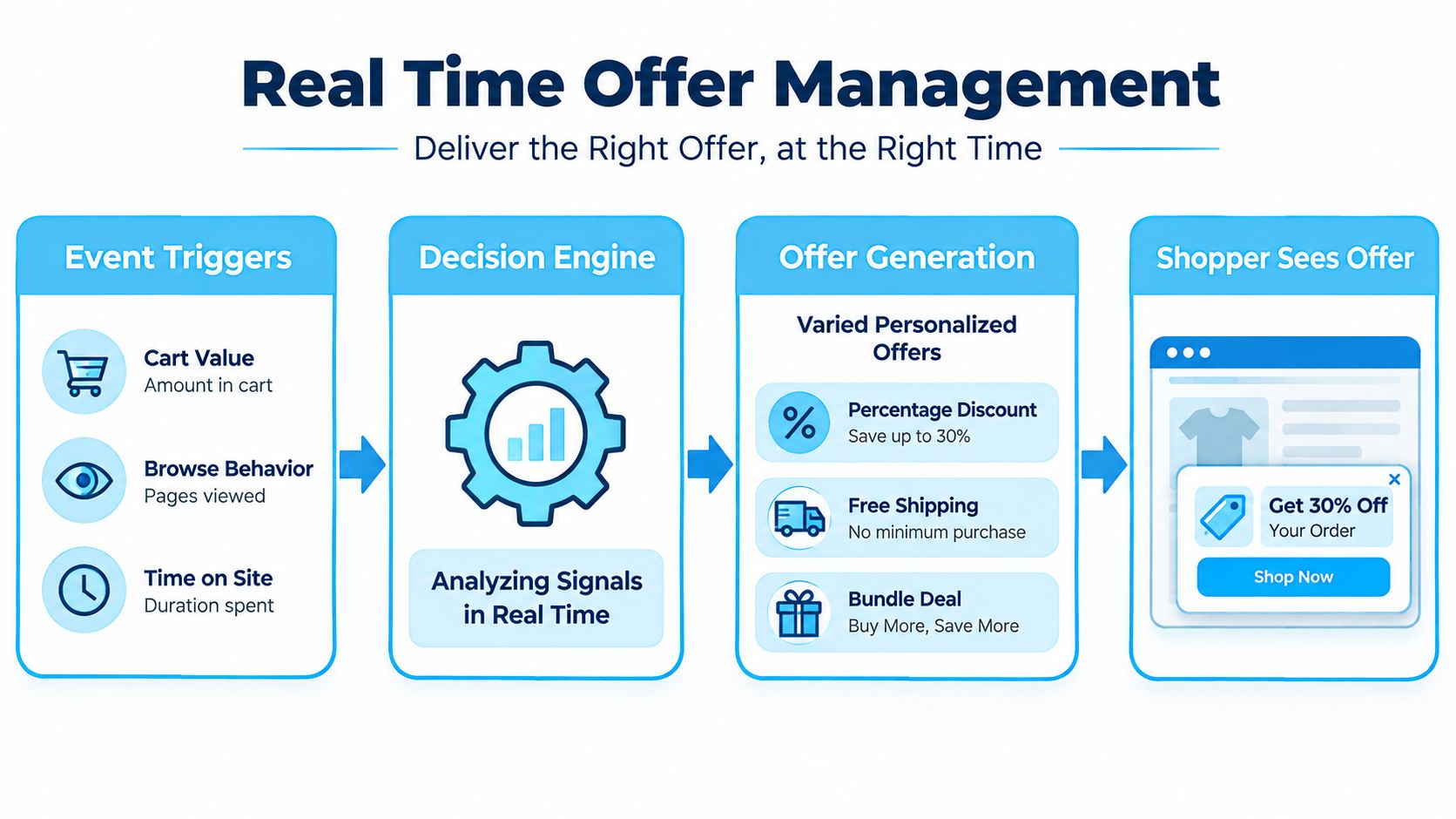
Real time offer management is the practice of evaluating a shopper’s context, the store’s inventory, and the campaign’s current state at the moment an offer is presented. The system then decides which shopper should see which reward, under what conditions, and whether that reward is still available.
A static coupon is like a flyer delivered to every home. It offers the same message regardless of who receives it, what they’ve bought, or how much inventory remains. A live offer is closer to a host managing limited seats. The host knows how many seats remain, who has claimed one, and what offer should be presented next.
The shift from static to responsive promotions
A useful real time offer has several parts:
- A trigger: The shopper reaches a defined moment, such as building a qualifying cart, returning to a product, signing up, or engaging with a message.
- An eligibility rule: The campaign checks whether the shopper, product, location, channel, or cart qualifies.
- A real constraint: The reward has a hard time limit, quantity limit, or both.
- A claim action: The shopper actively claims or accepts the offer instead of passively receiving an automatic markdown.
- A fulfillment rule: The checkout, inventory, and discount systems honor the same terms shown at the moment of claim.
That last point separates credible urgency from decoration. A countdown timer can display pressure, but it doesn’t make an offer scarce by itself. The system must enforce the remaining quantity or time when the shopper claims the reward.
What shoppers experience
For the customer, the experience can remain simple. A new visitor might receive a first-purchase reward, while a returning customer sees an incentive tied to a product they’ve revisited. A shopper with a higher-value cart could receive a better reward than someone with a smaller cart, provided the campaign’s economics support it.
The important change is participation. The shopper acts to secure a reward, and the brand controls the exposure rather than distributing a discount to everyone. That approach supports earned incentives, controlled availability, and clearer decision windows without requiring every customer to see the same promotion.
Consumer demand for this type of relevance is strong, while retailer capability has lagged. A 2020 enVista survey summarized by Retail TouchPoints reported that 74% of shoppers said personalized promotions and discounts would make them more likely to choose a store, but only 35% of retailers said they had successfully gained the ability to offer personalized promotions. The same report found that only 34% of retailers ranked customer identification and personalization as a top priority, and just 44% could access customer-specific information before checkout.
Why Scarcity and Urgency Drive Faster Decisions
Urgency works because it changes the shopper’s decision window, not because a louder timer makes a product more valuable. When customers believe an offer is expiring or a reward has limited availability, they perceive the opportunity as more valuable and become more likely to act before losing it. Reviews of ecommerce and live-commerce promotions connect time limits with faster decisions and quantity limits with stronger perceived exclusivity, as discussed in this review of scarcity-based promotional behavior.
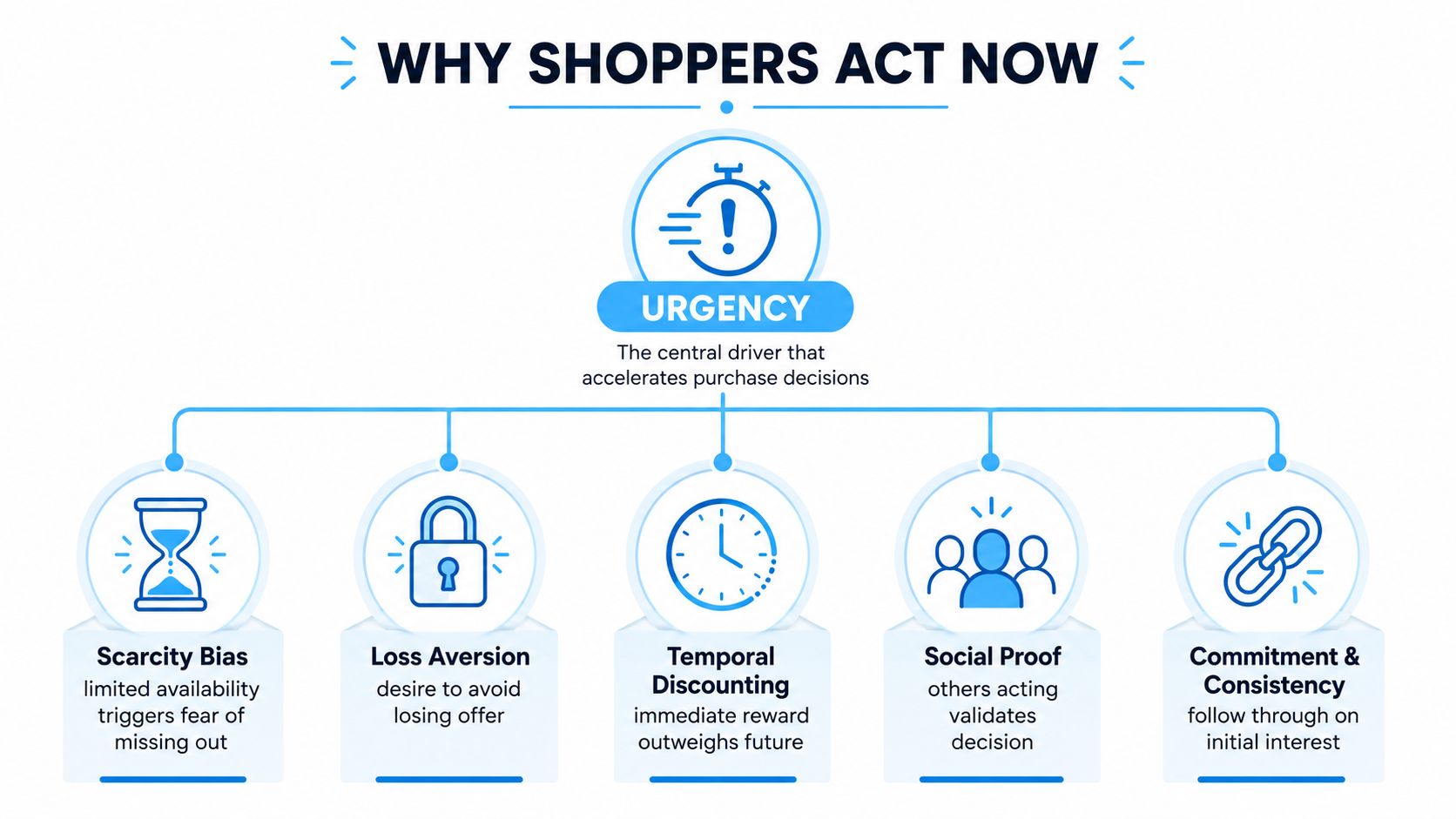
Five behavioral forces behind the decision
Scarcity bias makes limited availability feel more valuable. A reward available to every visitor feels ordinary. A reward with a credible claim limit feels worth securing.
Loss aversion makes the possibility of losing an available benefit more motivating than the possibility of gaining an equivalent benefit. “Claim this while it’s available” can be more actionable than “Save money someday.”
Temporal discounting explains why an immediate reward often carries more psychological weight than a larger but uncertain reward later. A shopper may prefer a modest benefit they can claim now over waiting for a possible future sale.
Social proof reduces uncertainty when shoppers see that other people are participating. It can validate a decision, but it must be presented accurately. A brand shouldn’t imply activity that hasn’t occurred.
Commitment and consistency begins when the shopper takes a small action, such as claiming a reward or joining an offer. That action can make completing the purchase feel more consistent with the decision they’ve already made.
These principles don’t mean every limited-time promotion will perform well. A 2023 study summarized by the American Marketing Association found that online time-scarcity promotions can be less effective than promotions without time limits because shoppers may recognize the retailer’s persuasive intent and become more skeptical.
Practical rule: Urgency works best when the constraint is real, visible, and immediately enforceable at the moment of claim.
A time-limited availability notice can raise perceived scarcity, perceived competition, and purchase intention, according to ecommerce research on limited-time scarcity. But the same logic creates a responsibility for the merchant. If the timer resets for every visitor, the quantity never changes, or the reward remains available after the stated deadline, shoppers eventually notice.
Why the offer must be consumable now
Scarcity has the strongest operational meaning when the shopper can claim the reward and use it without uncertainty. If inventory counters update slowly, two shoppers may receive the same final reward. If a discount tier changes after the customer reaches checkout, the experience feels arbitrary rather than urgent.
Limited-time offers can also create decision fatigue and impulse behavior, particularly when a brand uses them constantly. The research in this analysis of limited-time promotional cues describes countdowns, expiring coupons, and flash sales as mechanisms that can trigger fear of missing out and speed up decisions. That can be useful for a defined campaign, but repeated pressure without a clear customer benefit can damage trust.
The strongest system therefore combines psychology with discipline. It gives shoppers a reason to act, limits the reward transparently, and avoids turning every visit into a high-pressure event. For more practical examples of scarcity mechanics, see Quikly’s guide to scarcity marketing.
How Real Time Offer Management Works Behind the Scenes
The storefront experience may look simple, but a reliable offer depends on coordinated data and decision systems. A shopper’s cart value, browsing behavior, signup status, prior claims, product availability, campaign budget, and communication channel can all affect eligibility. The system has to evaluate those conditions quickly enough that the offer still reflects reality when the customer claims it.
Start with event triggers
An event trigger marks the moment when the system should evaluate an offer. Common triggers include:
- Cart value: A shopper reaches a threshold that could support a higher-value reward or bundle.
- Browse behavior: A visitor returns to a product or category after showing meaningful interest.
- Signup: A customer joins an email or SMS list and receives a reward tied to that action.
- Campaign activity: Claim velocity changes, causing the next reward tier to become available.
- Inventory state: A product or variant reaches a planned availability condition.
The trigger alone doesn’t determine the reward. It starts a decision that checks eligibility, exposure limits, inventory, and campaign rules. That prevents a visitor from receiving the same incentive repeatedly across several sessions or channels.
Enforce caps and tiers
A quantity cap limits how many shoppers can claim a reward. A time cap closes the reward after its defined window. A descending tier can offer a stronger reward early, then step down as more shoppers claim it. This structure rewards timing rather than patience, which helps prevent the familiar pattern where customers wait for a deeper markdown.
The counter must be authoritative. It can’t live only in a browser display or campaign dashboard. It needs to connect to the claim and checkout flow so the system can reject an expired or exhausted reward rather than allowing an invalid discount to proceed.
Near-real-time data pipelines support this work by combining transactions, web activity, customer interactions, and inventory levels. Guidance on real-time offers and analytics emphasizes that offer decisions depend on integrated operational data, not just a front-end promotion rule.
Keep the decision path fast
A large-scale ecommerce engineering case study describes event-driven serving with millions of requests per second, single-item retrieval around 50 ms P99, batch retrieval around 100 ms P99, and sub-10 ms P99 performance for some large-payload GET requests after an architecture redesign, as detailed by Zalando Engineering.
A Shopify merchant doesn’t need to reproduce that architecture, but the lesson applies. Fast read paths should retrieve precomputed eligibility, remaining-quantity state, and reward tiers, while slower upstream events update the model asynchronously. If every offer decision waits for several slow systems, the customer may see stale inventory or an outdated reward.
A practical architecture should also coordinate the storefront with email and SMS. A shopper who claims an offer on-site shouldn’t receive a conflicting message from Klaviyo later, and a reward shown in an SMS should carry the same eligibility and expiration rules when the customer returns to Shopify.
Implementing on Shopify Without Breaking Margin or Brand
Shopify merchants already have most of the building blocks. The challenge is making the offer logic agree with the theme, discount infrastructure, inventory rules, and customer messaging. A campaign that looks compelling but creates duplicate discounts, invalid codes, or confusing checkout conditions will cost more to operate than it earns.
Define the economics before the creative
Start with the behavior you want, then set the financial guardrails. A new visitor campaign may focus on first-order conversion. A cart campaign may focus on rescuing high-intent shoppers without giving the same reward to every site visitor. An average-order-value campaign can tie a reward to a cart threshold, a bundle, or a product category with enough margin to support it.
Write down:
- Eligible products: Include or exclude sale items, low-margin variants, and products with limited stock.
- Claim rules: Decide whether one customer can claim once, once per campaign, or once per channel.
- Discount interaction: Test how the offer interacts with Shopify discount codes, automatic discounts, subscriptions, bundles, and free-shipping rules.
- Fallback behavior: Decide what the shopper sees when the reward expires or the cap is reached.
- Brand expression: Match typography, color, language, imagery, and spacing to the existing theme.
For supporting creative production, teams that need affordable bulk image editing can prepare campaign assets without making the promotion look like a generic layer pasted over the storefront.
Use channels as one experience
A storefront offer can create the moment, while Klaviyo email, SMS, and social distribution bring qualified shoppers into it. Keep the source of truth in the campaign system, then pass the relevant claim state into each channel. Don’t send a “limited” reward to a list that can still redeem it after the cap has been reached.
Shopify and Shopify Plus merchants may have different options for discount logic, checkout customization, and integrations. In either case, test the complete path on mobile, including claim, add-to-cart, checkout, expiration, and a second attempt using the same customer identity.
Fit the tool to the behavior
Quikly is one option for Shopify teams that want to turn a standard promotion into a capped, claim-based experience. It supports rewards limited by quantity, time, or both, including descending tiers, and can distribute the experience across storefront, email, social, and SMS while matching the store’s branding. Its mechanics have been refined across more than 60 million consumer interactions, according to the publisher’s stated product information.
That approach differs from adding a basic popup or timer to a theme. The customer participates in claiming an available reward, while the merchant controls exposure and the campaign’s economic boundaries. For another perspective on context-aware merchandising, read real time personalization for ecommerce.
Measurement Testing and Pitfalls to Avoid
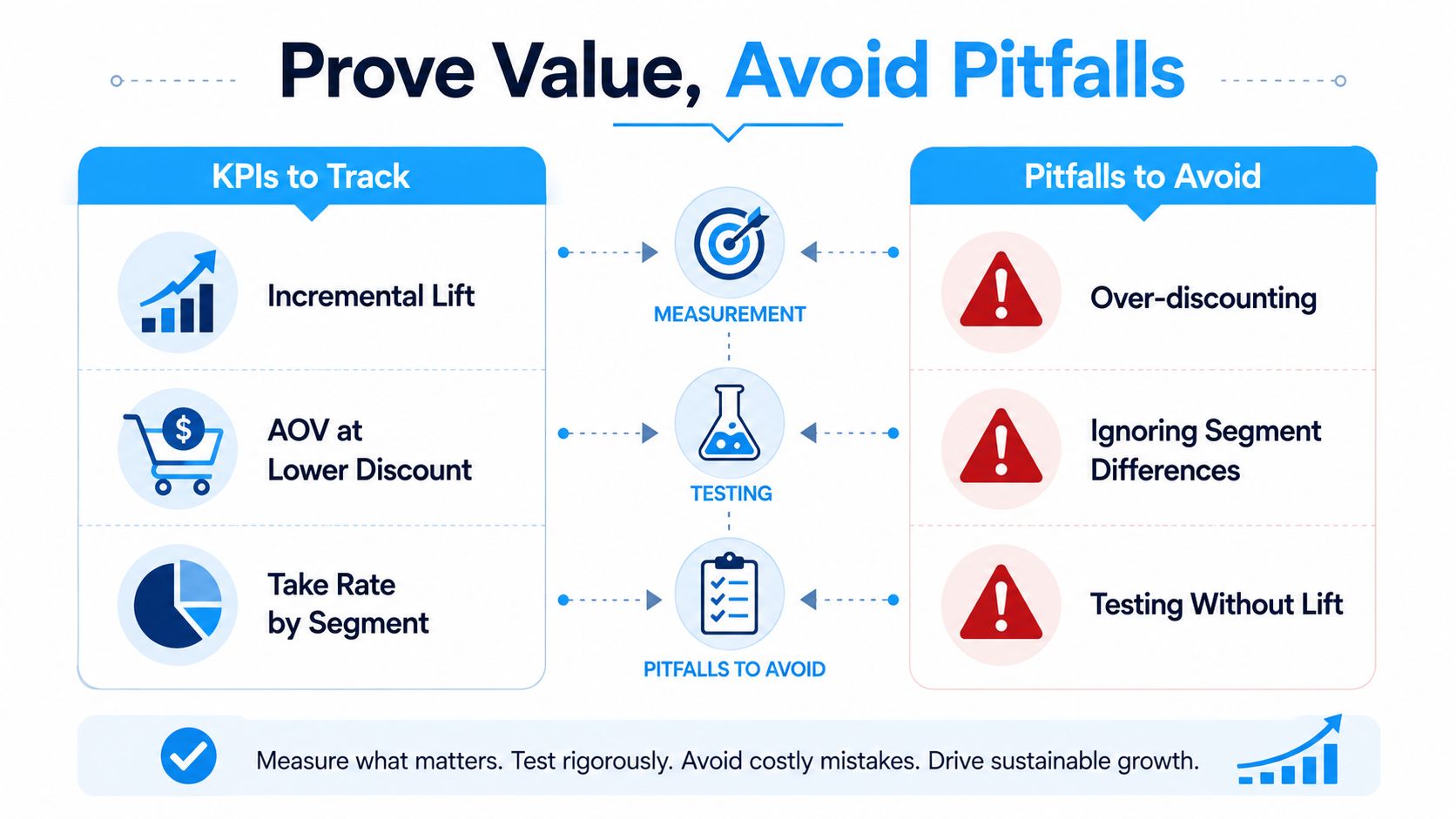
A real time offer should earn its place through incrementality and margin, not through a higher conversion number viewed in isolation. Compare shoppers who receive the offer with a holdout group that meets the same eligibility conditions but doesn’t receive it. Without a holdout, you may credit the promotion for purchases that would have happened anyway.
Track the economic outcome
Useful measures include:
- Incremental lift: Compare the treatment group with the holdout to estimate purchases caused by the offer.
- Average order value at a lighter discount: Check whether the campaign grows basket value without requiring a deeper markdown.
- Take rate by tier: See which reward levels attract claims and whether shoppers still act as the reward steps down.
- Claim velocity: Monitor how quickly shoppers consume the available reward and whether the pace creates operational risk.
- Email and SMS opt-in rate: Measure whether participation creates permission for future communication.
- Margin impact: Include discount cost, product margin, fulfillment considerations, and any channel expenses.
A campaign can show strong claim activity and still fail commercially if the reward attracts customers who would have purchased at full price. It can also appear weak on conversion while producing healthy incremental orders from shoppers who otherwise would have waited.
Watch for trust and operational failures
Personalized promotions can benefit the firm while creating downside risks for customers when shoppers perceive the targeting as unfair, intrusive, or manipulative. That tension appears in academic work on personalized online promotions, and it should shape campaign design.
The main failure modes are predictable:
- Overexposure: Showing the same reward on every visit makes participation feel routine.
- Stale counters: A shopper claims an exhausted reward because inventory or claim state updates too slowly.
- Latency breaks: Different channels show conflicting eligibility or expiration.
- Unclear terms: Customers don’t understand what they must buy or when the reward ends.
- Repeated replenishment: A discount returns on a predictable schedule, teaching shoppers to wait.
- Segment blindness: A reward that works for new visitors may unnecessarily subsidize loyal customers.
Improve the campaign by changing one operational variable at a time. Tighten the cap, vary the entry trigger, adjust the tier step-down, or send a post-claim message that helps the customer complete the purchase. Keep the control group in place while testing, and review margin alongside conversion.
For Shopify-specific promotion planning, use this guide to Shopify promos as a practical reference point.
Putting Real Time Offers Into Practice Today
Start with one buying moment, not a storewide transformation. Choose new-visitor conversion if paid traffic is arriving but first purchase intent is weak. Choose cart rescue if shoppers show strong intent but delay. Choose an average-order-value increase if customers need a clear reason to add another product.
Set a modest claim limit or a clearly defined time window, then decide what happens when the offer closes. Make the reward easy to understand, test the full Shopify checkout path, and compare results against a holdout. The first campaign should teach you how shoppers respond to the constraint, not just produce a short-lived sales spike.
The sharper mental model is simple: promotions should reward the shopper who acts now, not train the shopper who waits. A capped offer gives customers a reason to participate while giving the brand control over exposure, discount depth, and timing. Teams building campaign creative can also explore practical AI video generator articles for ideas on producing motion assets that explain an offer without relying on aggressive sales language.
Pick one product group, one trigger, and one success metric this week. Launch the smallest credible test, review incremental margin rather than raw orders, and use the results to refine the next buying moment.
Quikly helps Shopify brands run urgency and scarcity promotions with rewards capped by time, quantity, or both, including claim-based and descending-tier experiences across storefront, email, social, and SMS. If you want to replace blanket discounting with a controlled offer that rewards immediate action, visit Quikly and explore how the approach fits your next Shopify campaign.
Topics: real time offer management, Shopify promotions, ecommerce conversion, urgency marketing, personalized offers